In the world of proprietary trading firms, many traders focus primarily on passing evaluation challenges and securing funded accounts. However, once the excitement of becoming a funded trader fades, a crucial reality becomes apparent: trading costs matter more than most traders initially realize.
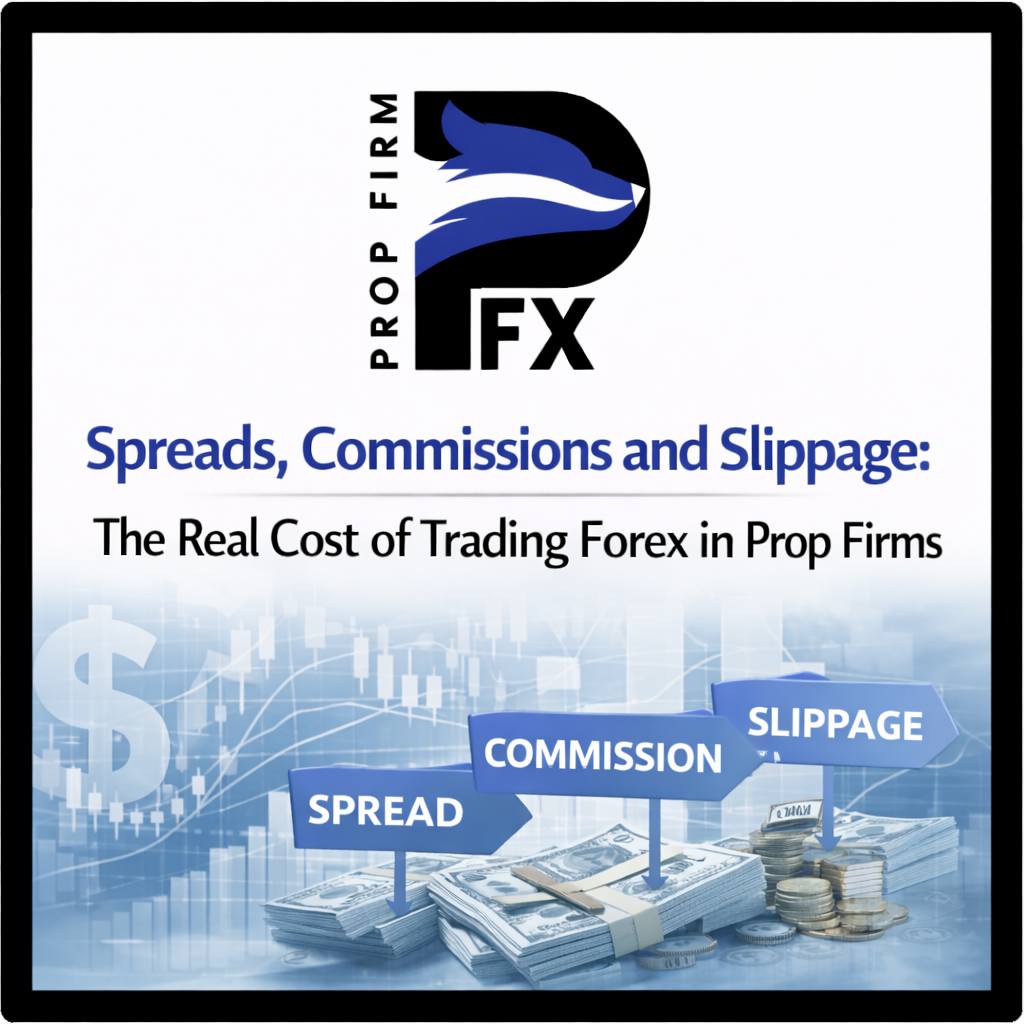
Spreads, commissions, and slippage may appear small when viewed individually, but together they can significantly impact a trader’s profitability. Understanding these hidden costs is essential for anyone trading Forex through a prop firm environment.
Why Trading Costs Matter More in Prop Firms
Unlike personal trading accounts, prop firm accounts often operate under strict rules: daily drawdown limits, maximum loss thresholds, and profit targets. Because of these constraints, even minor costs per trade can quickly accumulate and influence a trader’s overall performance.
For example, if a trader executes dozens of trades per week, a slightly wider spread or an additional commission fee can reduce the net profit margin considerably. Over time, these seemingly small differences can be the factor that determines whether a trader stays funded or violates risk limits.
In short, cost efficiency becomes just as important as trading accuracy.
Understanding the Spread
The spread represents the difference between the bid price and the ask price. It is one of the most common ways brokers generate revenue.
In Forex trading, spreads can vary depending on several factors:
- market liquidity
- trading session
- economic news releases
- broker pricing models
During highly liquid periods—such as the London and New York overlap—spreads tend to remain relatively tight. However, during quieter market hours or volatile events, spreads can widen significantly.
For prop firm traders who rely on precise entries and exits, wider spreads can reduce the reward-to-risk ratio of a trade before it even begins.
The Impact of Commissions
In addition to spreads, many prop firm brokers charge commissions per lot traded. These fees are typically applied on both entry and exit.
For example, a broker might charge a fixed amount per standard lot. While this may appear small on a single trade, it becomes more significant for active traders who execute frequent positions.
Scalpers and intraday traders are particularly affected by commissions because their strategies rely on capturing relatively small price movements. In such cases, the commission can represent a meaningful portion of the potential profit.
Slippage: The Hidden Variable
Perhaps the least understood cost in Forex trading is slippage.
Slippage occurs when a trade is executed at a price different from the expected one. This can happen during periods of high volatility, low liquidity, or when markets move extremely quickly.
For instance, if a trader attempts to enter a position at a specific price but the order is filled a few pips away from that level, the difference represents slippage.
While slippage can sometimes be positive, it is more often negative in fast-moving markets—especially around major economic announcements or geopolitical events.
Over time, repeated slippage can noticeably affect the performance of a trading strategy.
The Combined Effect on Profitability
When spreads, commissions, and slippage are considered together, their cumulative impact becomes clear.
A strategy that appears profitable in backtesting may perform very differently in live conditions if these costs were underestimated. Even a trading system with a high win rate can struggle if the average trade size is small and transaction costs are high.
This is particularly important in prop firm environments where traders often aim for consistent, incremental gains while respecting strict risk parameters.
How Traders Can Reduce Trading Costs
Although traders cannot eliminate these costs entirely, several approaches can help minimize their impact:
- trading during the most liquid market sessions
- avoiding high-impact news events when spreads widen
- choosing strategies that account for realistic trading costs
- monitoring execution quality and broker conditions
Being aware of these factors allows traders to adapt their strategies and manage expectations more effectively.
A Cost That Cannot Be Ignored
While many discussions about prop firms focus on evaluation rules and payout structures, the true cost of trading often receives far less attention.
Spreads, commissions, and slippage may seem minor individually, but together they form a critical component of trading performance. For funded traders working under strict risk limits, understanding and managing these costs can make the difference between consistent profitability and repeated setbacks.
In Forex trading—especially within prop firms—success is not only about finding good trades. It is also about controlling the invisible costs that come with every position.